
Extension leadership
for the IRREC Aquaculture Demonstration Project
Dr. Cortney Ohs’ extension program provides leadership in aquaculture production of fish and crustaceans, both marine and freshwater, and various related fields. This program has developed as a logical extension of my research program and professional experience. Deliverables for my program include the development and delivery of educational materials and presentations. Additionally, Dr. Ohs facilitates the transfer of current research results and issues to stakeholders, including current and potential aquaculture producers, extension and sea grant agents, county and city administrators and staff, and the Florida Department of Agriculture and Consumer Services. The aquaculture products Dr. Ohs deals directly with include food and baitfish, food and bait shrimp, aquaculture production systems including ponds, cages, and recirculating aquaculture systems, live feeds for larval fish and crustaceans, and algae production. The program comprises two focus areas. Focus one is to disseminate new opportunities for producers to diversify and improve their economic efficiency. Focus two is to develop and implement an aquaculture curriculum in middle and high schools.
-
Focus Area #1
Mission
Expanding Knowledge about Aquaculture and New Opportunities and Technologies Available to Current and Potential Producers
Program Objectives
- Educate producers, allied industry, and county extension and sea grant faculty about research and demonstration results on new aquatic species with production potential through extension meetings, in-service training, and extension publications.
- To inform candidate producers about aquaculture as a potential business venture by disseminating accurate information, including verbal, written, and electronic documents.
- Conduct applied research projects to answer critical questions for producers.
Situation Worldwide
In 2006, the Food and Agriculture Organization of the United Nations (FAO) reported that 46.4% of the seafood consumed in the world was cultured. The scale of world aquaculture production is not well known by the general public in the United States because other countries dominate production.
Situation in Florida
In Florida, there is a great deal of interest in aquaculture and diversification of traditional agriculture. The potential for integration of aquaculture production in ponds, cages within the ponds, or in recirculating tank systems within existing farms is strong. Many traditional agriculturists in Florida have the required natural resources of climate, water, and land to initiate the production of various aquatic organisms.
Current aquaculture producers are interested in determining methods to improve the margin on their crops. One method the producers use to increase profits is to implement new techniques and diversify the number of species they produce. Commonly, producers will successfully culture an aquatic organism, but they do not know the optimal culture methods and parameters to maximize their production. Most producers are not able to properly evaluate various culture conditions in replicated studies. Therefore, applied research conducted at the IRREC Aquaculture Demonstration Project is critical to producers because the producers are able to apply scientific research findings from university research to the aquaculturalist's operations.
UF/IFAS IRREC Aquaculture Research Serves Industry:
With the scientific findings, the producers can improve the efficiency and profit margin of their aquaculture farms. Both current and potential producers need accurate information to make informed business decisions. In the IRREC Aquaculture researchers’ efforts to provide clients with the best possible information, Dr. Ohs uses published extension literature, develops new extension publications, develops and maintain websites, and make presentations to producers. Dr. Ohs' presents educational sessions to stakeholders, county extension agents, sea grant faculty members, state agency leaders, students of all ages, and city and county officials.
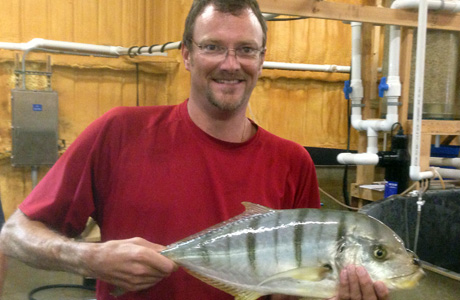
Dr. Cortney Ohs -
Focus Area #2
Development and Implementation of an Aquaculture Curriculum in Middle and High Schools
Situation:
In 2007-2008, 18 middle and high schools in Florida offered formal aquaculture programs certified by the Florida Department of Agriculture and Consumer Services Division of Aquaculture. The teachers who led the programs did not have a curriculum which efficiently met the required Florida Sunshine State Standards. Additionally, there was great interest in many schools to develop an aquaculture program. Still, their principal or districts could not allow them to do so without having a curriculum to implement. To meet the educational need, Dr. Cortney Ohs led a team to develop an aquaculture curriculum that met the required Sunshine State Standards. Then we recruited and educated teachers about aquaculture and how to implement the curriculum into their classrooms. This project was funded by the Florida Aquaculture Review Council 2008-2009. Program Objectives:
- Develop a curriculum on aquaculture and the aquatic sciences for middle and high schools in Florida, which meets Sunshine State Standards
- Recruit teachers to implement the curriculum and teach them about aquaculture and how to implement the curriculum in their classrooms
- Increase the number of middle and high schools in Florida that have an aquaculture program and teachers who use aquaculture activities in their classrooms
- Inform the next generation about aquaculture by providing their teachers with a curriculum
Teach Aquaculture Website
Access the Teach Aquaculture Website
Dr. Cortney Ohs' educational efforts and activities involved development of curriculum for aquaculture and the aquatic sciences for middle and high schools in Florida. The curriculum is titled “Teach Aquaculture,” a set of seven modules of material for the target age cohort. Each module consists of classroom activities with detailed instructions, supporting extension documents, assessments, and PowerPoint presentations. Twenty-four activities are inside the seven modules. A team of aquaculture instructors from middle and high schools reviewed the set of activities. Also, each activity was beta tested by 50 teachers while they attended an associated workshop held by a scientist with Harbor Branch Oceanographic Institute at Florida Atlantic University.
- The Teach Aquaculture website platform is available to instructors worldwide
- Teach Aquaculture visitors create a username and password, and provide their name, contact information, and their role as an aquaculture instructor
- Also recorded are the specific documents and the number of documents users access and download. Collected data allows researchers to measure the number of users and their interests
- IRREC Aquaculture researchers follow up with Teach Aquaculture visitors and provide surveys to determine the effectiveness of each module