
IRREC Aquaculture Research
Aquaculture is the husbandry of an aquatic organism in a controlled environment. The aquaculture industry in Florida has been dominated for decades by the production of freshwater ornamental fishes. The purpose of my research program is to diversify aquaculture production by developing culture methods for new aquatic organisms and determining their potential for commercial production.
Research Focus Areas
Marine Baitfish culture involves production of fish used as bait for Florida’s sportfishing industry. Larval culture using live feeds involves copepods and utilizing them as a first feed for larval marine fish. The development of fish diets and methods to condition and spawn brood fish is important for commercial aquaculture operations. Each of these areas increases the potential for culture of new species by defining methods to alleviate critical bottlenecks which have prevented successful culture and commercialization.
-
Marine Baitfish Culture
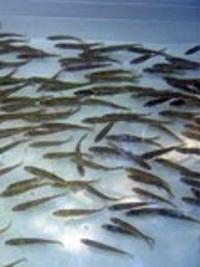
Bull MinnowsResearch for Marine Baitfish Culture defines culture methods to close the life cycle of several fish species commonly used as bait. Florida's $6.6 billion saltwater sportfishing industry is important to the economy. Currently, almost all marine baitfish are harvested from the wild. The supply is seasonal, and for most of the year the demanded species and/or sizes of baitfish are not available. Aquaculture baitfish producers do not need special marketing efforts because established retail markets exist in every coastal county throughout the state. And, marine baitfish are in high demand.
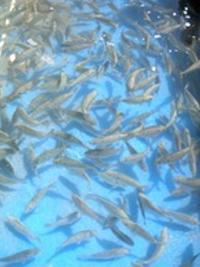
PinfishResearch at the Aquaculture Laboratory for marine baitfish has defined culture methods of three new species. The IRREC lab was the first to close the lifecycle of two species. Continued research will refine culture methods of these species and define methods for year round and low salinity production.
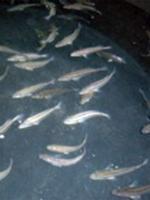
PigfishOne attractive attribute of some marine fish is their ability to survive and grow in low saline waters. Because the marine species is able to live in this environment, the circumstances facilitate marine aquaculture to occur in inland low saline waters. The result of the situation is that high-valued marine organisms can be cultured away from expensive and developed coastal property.
-
Larval Culture Using Live Feeds
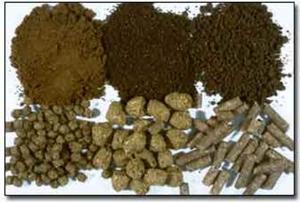 Members of the aquaculture industry have expressed a great desire to culture many species of high value marine food fish and hundreds of species of marine ornamentals. Currently, the bottleneck to their production is the larval stage. This stage requires very small live food organisms to be fed to the larval fish. For the past decade, larval culture methods have used rotifers and brine shrimp (Artemia sp.) for live food, but successful culture is limited to a few species. Neither of these organisms are the natural prey of marine fish and are used because they are commercially available. Additionally, their nutritional composition will not support the growth and survival of larval fish unless they are enriched with nutritional additives. The natural prey of larval marine fish is copepods. There are 24,000 species of copepods identified and they are so numerous in the oceans that they represent the greatest biomass of any organism in all of the world’s oceans, even though their size ranges from 60 to 1000 µm. There is a growing research effort worldwide to isolate and culture individual species of copepods in tanks to produce the necessary small naupliar stage to feed larval marine fish.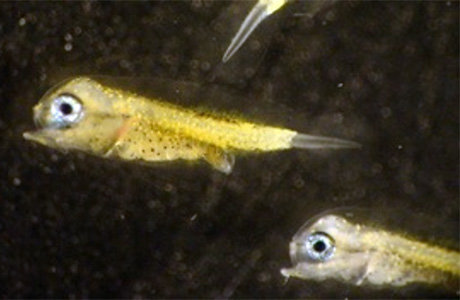
Pompano Larvae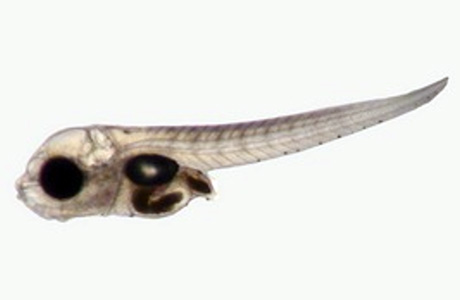
Pinfish LarvaeResearch at the IRREC Aquaculture Demonstration Project with copepods includes isolating and evaluating new species. Researchers aim to determine if the copepods are conducive to culture in tanks. A second goal is to identify and develop optimal culture conditions for each species. Additionally, aquaculture researchers are feeding copepods to marine fish larvae. The research objective is to compare the copepods' performance to larvae fed rotifers and Artemia sp. The long-term research objective is to develop many marine fish, including ornamental, bait and food species, for commercial production. Larvae can be successfully cultured with copepods.
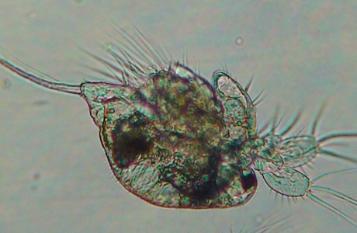
Copepod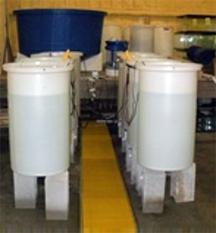
Copepod Tanks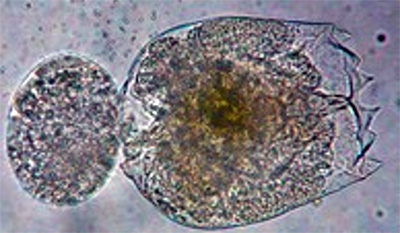
Rotifer -
Fish Diets to Spawn Brood Stock
Objectives: To define culture methods, including broodstock development, spawning, egg hatching, larval culture, and growout to market size. All of the following species of fishes were successfully cultured in the Ohs UF/IFAS-IRREC Aquaculture Laboratory for the first time ever:
- African Moony
- Golden Trevally
- Ballyhoo
- Pacific Blue Tang
- Cuban Hogfish
- Reef Butterflyfish
- Banded Butterflyfish
- Clown Pleco
- Dwarf Suckermouth
View Images and information about the fish species above.
A third research aim at the IRREC Aquaculture Demonstration Project is to evaluate brood nutrition of two commercially important freshwater ornamental fish:
- Redtail Black Shark (Epalzeorhynchos bicolor), and
- Mono Sebae (Monodactylus sebae).
Research for the two species is funded with a USDA grant and is part of a larger regional project to investigate broodstock nutrition of fish. For most species of fish, there is minimal information on broodstock nutrition. It is known that brood fish require additional nutrition during egg and sperm development. However, the effects different levels of fatty acids have on ornamental fish reproduction are unknown. Researchers at the IRREC facility formulated diets to measure the effects of altering the fatty acid composition of brood diets.